Showing posts with label space. Show all posts

Wednesday, 14 October 2015

Interstellar Radio Propagation


Proxima Centauri: The Closest Star.
Credit & Copyright:  David Malin, UK Schmidt Telescope, DSS, AAO

It's a staple of Science Fiction, and an unquestioned fact of our modern age, that aliens could be listening to our radio and watching our TV broadcasts, as our signals race across the galaxy at the speed of light.  They could be studying our weaknesses, preparing their attack!  But really, is that possible?
 
I have long been fascinated by the possibility of finding life beyond our solar system, or of aliens finding us.  But rather than wishful thinking, scaremongering or falling for alien abduction tales, I'm far more interested in the realistic prospects of such a discovery.  So when Prof. Brian Cox threw down the gauntlet for listeners to BBC Radio 4's The Infinite Monkey Cage to carry out a fundamental but accessible calculation to illustrate the real likelihood of one form of contact, I was fascinated.
 
Episode 5 of Series 12 was broadcast on 3 August 2015, and I heard it several weeks later via the show's podcast feed.  The previous week's episode focussed on extra-terrestrial life and alien contact, but Episode 5 concentrated on speed, including land speed record attempts as well as the fundamental barrier in physics that is the speed of light.
 
If you want to download and listen to the episode yourself, at 38m 38s, presenter Robin Ince asks about radio signals leaking into space and Professor Danielle George, of University of Manchester, describes broadcast transmissions degrading in power with the inverse square law. Then Robin asks Brian Cox to calculate how far away through space their own radio broadcast would be detectable. Prof. Cox ad lib ponders the problem and then defines the listeners' challenge, which I summarise here:
"Suppose a 200kW transmitter broadcasts for 1 second at 198kHz, find the distance at which there remains one photon per square metre."

Now, we can argue the merits of this threshold, whether one photon per second per square metre is easy or unduly difficult for advanced aliens to detect, (and I shall return to this question).  But for now, let's solve the problem.

First, we need to know how many photons of radio energy are transmitted in one second.  Then we need to find the distance at which all these photons are spread out to one per square metre.
 
So let's do it...  First, let's define some parameters and constants:

Transmitted power,       P = 200kW
Frequency,                    f = 198kHz
Planck's constant,         h = 6.6x10⁻³⁴Js
 
As Prof. Cox helpfully reminded us, the energy of a photon is given by its frequency multiplied by Planck's constant, so
 
Photon energy,             E = hf
 
So each photon at 198kHz carries 198x103 x 6.6x10-34 = 1.3x10⁻²⁸J of energy.
 
And since a power of 200kW delivers precisely 200kJ of energy per second, in one second the transmitter delivers 200kJ of energy.
 
So we divide the energy transmitted by the energy per photon to find the number of photons transmitted.
 
Number of photons, N = 200x103 / 1.3x10-28 = 1.25x1033 photons.
 
That's an awful lot of photons!  So now we need to spread these photons out over a sphere to the point where there's one square metre of area on the sphere for each photon.
 
The area of a sphere, A = 4πr2 m2, where r is the radius of the sphere.
 
So, a sphere with an area of 1.25x1033 is given by the equation 1.25x1033 = 4πr2.
 
Rearranging this to find r gives, r = √( 1.25x1033 / 4π ) = 1.0x10¹⁶ metres.
 
That's an unfeasibly large distance by human standards, but on the astronomical distance scale, it's almost exactly one light year!
 
So once the Radio 4 long wave signal broadcasting The Infinite Monkey Cage gets to a light year from Earth, it will comprise only one photon per square metre, per second.  And by Brian Cox's criterion, it will have degraded to the point of undetectability.
 
Now bear in mind that the nearest extra-solar star, pictured above, is Proxima Centauri which is 4.2 light years away.  And if that was conducive to intelligent life, which it is not, our signal would not make it a quarter of the way there.  So by this criterion, which is not unreasonable at all, we are to all intents and purposes radio silent to any alien life out there, as far as commercial broadcast transmissions are concerned.
 
=====
 
So now, how reasonable is this as a limit?  Can we find an argument which breaks this?
 
One photon per square metre per second seems like an arbitrary limit, why can't advanced aliens detect those? Well, as advanced as aliens might be, there has to be a signal to receive.  The bandwidth of an audio signal is a few kHz, which means that you'd need at least 5,000 samples per second to reconstruct the transmitted signal.  And that's not a technological limit, which advanced civilizations could surpass, it's a fundamental information limit.  Worse still, one photon carries no amplitude information, so unless the reconstruction is to be distorted beyond use, they would need to detect many photons per sample.  A good signal would use several hundred amplitude levels, but you could get away with perhaps 20 or so.  So now, to reconstruct a useful signal, you'd need 100,000 photons per second.  At just one light year, that would require a receiving antenna with an area of 100,000m2, or a perfect dish with a diameter of 350 metres (1,200 feet).
 
But aliens have limitless capabilities, because... well, aliens! So they could build a 350 metre dish.  Well, perhaps.  But now consider that signal power drops with the square of distance, and dish area increases with the square of diameter.  So double the distance, double the dish diameter.  There are plenty of stars nearby, but to find one which can possibly be inhabited by life which could evolve to sufficient intelligence, we need to look tens of light years away. Say fifty light years.  So now they need a dish fifty times bigger, that's 18km (11 miles) across.  And to search their neighbourhood to a fifty light year radius, they'd need to steer that, and keep it adequately parabolic too.  Consider too that fifty light years is on the extreme edge of optimism for reasonable numbers to plug into the Drake Equation, and the probability of another technologically advanced lifeform existing within 50 light years from us is not zero, but it must be very, very low.
 
So what about higher powered transmitters?  The 200kW BBC Radio 4 long wave transmitter is fairly typical for its waveband.  The Europe 1 transmitter in Germany is about the most powerful long wave transmitter on the planet, pushing out 2000kW at 183kHz.  That'll increase range by about three times, to 3 light years.  In terms of astronomy, that half an order of magnitude  and makes little difference to the feasibility of being heard.  It increases Brian Cox's limit from a light year to three, still well short of Proxima Centauri.
 
How about other wavebands?  Our atmosphere only allows through certain wavebands.  Long wave will get through, short wave will not.  Above that, VHF radio and UHF TV transmissions can get through, but as frequency increases, so does the energy in each photon.  So at higher frequencies, the number of photons for the same power is proportionately less, and so the range to receive sufficient photons to reconstruct the transmitted signal reduces too.  The upshot is, signals at frequencies above long wave will be undetectable closer rather than farther out.
 
You've only considered omni-directional signals, how about directed beams?  Well, yeah.  If you're talking SETI listening to the equivalent of Arecibo, then that's a different question entirely.  What I'm talking about is our routine commercial broadcast transmissions.  Many of those are vaguely directed, particularly the higher frequency transmissions.  And those already suffer from worse propagation issues than long wave.  But it's true that a directed transmission is more powerful than an omni-directional one, (one which transmits equal power in all directions).  And although the power density increases in the transmitted direction, the area of sky covered reduces, reducing the likelihood of any receiver within range detecting the signal.  So directed broadcast transmissions don't help us.
 
=====
 
Finally, let me be clear: I'm not saying that it's impossible for our transmissions to be detected by alien civilisations, if they exist.  But what I am saying is that the above is a reasoned argument supported by calculation that it's very, very improbable that there could be any within receiving range.  It's just not as easy as E.T. sitting on a planet orbiting, say, Tau Ceti with his transistor radio, listening to Hancock's Half Hour or I Love Lucy.  If we're going to make contact with technological civilisations, we'll need a highly funded, planned and directed effort.  Trusting on radio broadcasts leaking into space isn't going to cut it.

Tuesday, 26 July 2011

Orbital Mechanics for Dummies - Orbital Energy

Now we're going to consider the energy in an orbit, and we'll consider two forms of energy: kinetic energy from the speed of motion around the central body; and gravitational potential energy by virtue of the forces in a gravitational field, (which we'll call gravitational  energy for short).

First we need to consider a reference point.  Here on Earth, it is tempting to consider being at rest on the ground to be the zero orbital energy point.  But that means for flight between different planets we have different references to consider and that won't do.  The solution is to consider the reference point to be stationary at an infinite distance from the central body, where the gravitational field is zero.  Then we can use this reference for flight between as many different bodies as we wish.

Kinetic energy is easy, and from high school physics I remember it is given by

Ek = ½mV²

But from our equation [1] we found that in a circular orbit,

VC² = GM/r

So in such an orbit,

Ek = ½GMm/r = GMm/2r   [2]

This is an important equation and we'll call it [2].  Just take a moment to consider what this means: the kinetic energy of a body in circular orbit is proportional to the masses of the bodies, and inversely proportional to the distance between them.  So as the mass of either body increases, so the kinetic energy increases.  As the distance increases, so the kinetic energy decreases.  This fits with equation [1] which told us that as distance increases, so orbital speed decreases.

Now gravitational energy is a little harder to understand.  It is the work done by gravity to bring a body from infinite distance to a radius r from the central body.  At each step along the way, the gravity from the central body applies a force of GMm/r².  At each step dr along the way from infinity to r, the work done is the force GMm/r² multiplied by the distance dr.  And we add all those steps together by integrating the force from infinity to r as follows:

If calculus puts you off, feel free to take my word for it and skip to equation [3]

Eg = r GMm/r² dr 

=  GMm  r 1/r²

= GMm  [-1/r]r

= -GMm  [  (1/r)  - (1/∞) ]

= -GMm  [  (1/r)  - 0 ]

Eg = -GMm/r     [3]     <= equation [3]

This too is an important equation and we'll call it [3].  Just take a moment to consider what this means: the gravitational energy of a body in circular orbit is proportional to the masses of the bodies, and inversely proportional to the distance between them.  But it has a minus sign, I hear you say.  Yes indeed, and that means that gravitational energy increases (becomes less negative) as an object is lifted away from the central body.  That fits with the idea that energy is required to do work in lifting the object.  It also has some convenient consequences for orbital mechanics which we'll see later on.

Now that was the hardest piece of maths we'll do in this series, and there is no further calculus at all!  Whether you followed the integration or skipped it, please go back and make sure you understand these two energies because they lay the foundation for truly understanding orbits, and all kinds of interplanetary travel.

To wrap up orbital energy, we'll add kinetic energy and gravitational energy together into a single value.

Eo = Ek + Eg

= GMm/2r - GMm/r

Eo = -GMm/2r     [4]

Notice that orbital energy is negative, and increases in value as radius increases.  It's as though this energy represents how far the body is located down into the gravity well of the central body.  And if you imagine raising this energy past zero to a positive value as representing the orbiting body climbing out of the gravity well, then this will lead nicely on to the concept of escape velocity which we'll cover next time.

That's enough for this post.  Next time we'll consider how energy oscillates between kinetic and gravitational energies in elliptical orbits, and look at escape velocity.

Monday, 18 July 2011

Orbital Mechanics for Dummies - Kepler's Third Law


This post is an aside.  Here I show how to prove Kepler's third law of planetary motion from what we have done so far.  Nothing which follows depends on it, and if you choose to skip this post then you will lose nothing of substance from the series on Orbital Mechanics.

Kepler's third law states that

the square of the period of a planetary orbit is proportional to the cube of its distance from the Sun.

In one orbit, the orbiting body travels a distance equal to the circumference of the circle with radius r.  This distance is 2πr.  So the time taken to travel this distance, or the period of the orbit in seconds, P, is given by

P = 2πr / VC

Taking the square of both sides gives

P² = 4π²r² / VC²

Now from our last post we know that

VC² = GM/r

Putting this into the equation for the period squared gives

P² = 4π²r² / (GM/r)

which simplifies to

P² = 4π²r3 / GM

Now if this equation is applied to planets orbiting the Sun, then the square of period of the orbit, P², is directly proportional to the cube of the distance from the Sun, r3.  So we have proved Kepler's third law.

Sunday, 17 July 2011

Orbital Mechanics for Dummies - Circular Orbits

Last time we looked at the kinds of basic orbits, and gave a description of how the orbiting body moves in each.  Now we will dip our toe in the maths water.

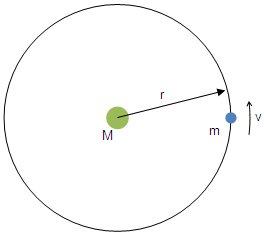
The first step is to define the parameters of the orbit, according to the following diagram.


M is the mass of the central body, in kilograms (kg).
m is the mass of the orbiting body, in kilograms (kg).
r is the orbital radius between the centres of the bodies, in metres (m).
v is the speed at which the orbiting body moves around the central body, in metres per second (m/s).

There are a few other parameters we'll use along the way:
G is Newton's gravitational constant, and is equal to 6.67 x10⁻¹¹ m3/kg/s2.
VC is the speed of a body moving in a perfect circular orbit, in metres per second (m/s).
VE is the speed of a body moving just fast enough to escape from orbit, in metres per second (m/s).
A is an acceleration, expressed as a change in speed per second (m/s²).
From the previous post we know that for a circular orbit the orbiting body moves under centripetal acceleration which is provided by the gravity field of the central body.  So we need formulae for both centripetal acceleration and gravitational acceleration.

From high school physics we recall that centripetal acceleration is given by

AC = V²/r

and gravitational acceleration is given by

AG = GM/r²

Now since centripetal acceleration is provided by gravitational acceleration, AC = AG so

V²/r = GM/r²

and because we can eliminate the /r on each side, and in a circular orbit V = VC

VC² = GM/r  [1]

There we have it, our first equation for orbital mechanics.  Wasn't so hard, was it?   It's such an important equation that I've labelled it [1] so we can refer to it again.  What it tells us is that the square of the orbital speed is proportional to the mass of the central body, and inversely proportional to the orbital radius.  The constant of proportionality is Newton's gravitational constant.

Example
To try this out, let's work out how fast the International Space Station (ISS) travels around the Earth.  As I remember, it's around 17,500mph.  But can our equation [1] confirm that?

The mass of the Earth is 5.97 x1024 kg.
The radius of the Earth is 6.37 x10⁶ m.
The ISS orbits at 350km above the surface, so the orbital radius is 6.72 x10⁶ m.

VC² = GM/r = 6.67 x10-11 x 5.97 x1024 / 6.72 x106 = 59.3 x10⁶.

Taking the square root gives
VC =7,700 m/s.

Since there are 1,610 metres in a mile, and 3,600 seconds in an hour,

Orbital Speed = 7,700 x 3,600 / 1,610 = 17,200 mph.

That works for me!  Next time we'll take on the giant of orbital mechanics and prove Kepler's third law.

Saturday, 16 July 2011

Orbital Mechanics for Dummies - Orbital Basics

I’m going to deal with very simple situations, as these make both understanding and the maths easier, and most real situations can be usefully approximated by these simple cases.  The central body is vastly more massive than the orbiting body, so we can consider the central body to be fixed, and just work on the orbiting body.

The simplest orbit is perfectly circular.  The orbiting body moves in a circle at just the right speed so that its centrifugal force is precisely balanced by the gravitational force between the bodies.  We will call that speed VC.

Now physics purists will tell us that centrifugal force is an illusion, so to satisfy them we’ll consider acceleration rather than force and describe the orbit as the path where centripetal acceleration is provided by the gravity of the central body.  We’ll do the maths for this in the next post.  For now, here’s the circular orbit as a diagram.


A variation of this orbit is the elliptical orbit.  If at point A the orbiting body accelerates by a small amount, (less than 41% of VC), then as it proceeds around the central body its extra speed will cause it to climb away from the circular orbit path.  As it climbs against the force of gravity from the central body, the orbiting body decelerates.  It reaches its furthest point at B, directly opposite A, and begins to accelerate back towards the original point A once again.


Point A, the closest to the central body, is called periapsis.  Point B, the furthest from the central body, is called apoapsis.

When the orbiting body is at point B, it is travelling more slowly than the circular orbit speed, VC’, at that radius from the central body.  Now if the orbiting body accelerates again at point B, to VC’, it will follow a new circular orbit passing through B.


This kind of manoeuvre, where an elliptical transfer orbit is used to change between orbits of different radii, is used frequently in space flight.  Some satellites are put into geostationary orbits, where they orbit once in 24 hours and appear stationary over particular points on the equator as the Earth rotates.  When a geostationary satellite is launched, it is inserted into a transfer orbit with apoapsis at the geostationary radius.  Then a dedicated engine is fired at apoapsis to accelerate and achieve a circular geostationary orbit.  A variation of this kind of transfer orbit was used by Apollo spacecraft to reach the Moon.

Finally, if the orbiting body accelerates by 41% of VC or more, then this speed causes it to climb away as before, but this time it is travelling fast enough that the gravity field from the central body reduces more quickly than the body decelerates, and the body continues climbing indefinitely.  The body has exceeded the escape velocity, VE, has escaped the gravity field and will not return.


These are the basic principles to grasp for now.  Next time we will look at some simple maths to describe these different cases.

Orbital Mechanics for Dummies - Introduction

I have been following the Dawn mission to asteroid Vesta with keen interest.  The mission team is relying on simulation data because for various reasons accurate measurements of the probe's position are only available occasionally.  The probe is expected to achieve orbital insertion around Vesta today, but without accurate data not available until tomorrow, we can only speculate on whether orbit has been achieved.

For hour-by-hour data, the team relies on the MYSTIC simulator.  This gives vital data including Dawn's speed in relation to Vesta, and its range to the asteroid.

I'm no rocket scientist, but I do have basic skills in physics and maths, and a keen interest in space flight.  A number of years ago, I worked out my own very basic system for understanding orbital mechanics, including the basic equations for simple orbits, from first principles.  I used these, with the simulation data, to show that Dawn appeared to have achieved orbital insertion around Vesta earlier this morning.

I have discussed my calculations with others interested in this mission.  It occurs to me that there may be other keen amateurs out there interested in understanding the basics of orbital mechanics.  So it is my intention to publish a series of posts on the subject.

It won't be for everyone, by a long way.  But if you have a good grasp of high school physics and maths, you should be able to follow along.  My own maths ability reached its limit shortly after high school level, so I haven't included anything too demanding!  It also won't satisfy real rocket scientists, who use levels of calculus way beyond me and can tell you all the fundamentals I've missed out.  However, if my basic version is flawed rather than just simplistic, then I'd really like to be corrected so please do get in touch!

If you're interested, keep an eye out for my following posts which detail my Orbital Mechanics for Dummies...

By the way, the title is not intended to patronize.  I consider myself to be a mathematical dummy, at least compared to the abilities of my peers when I was studying.  My aim is to use my limited skills to understand how orbits work, and how to work out their parameters.  There are plenty of more complete works on the subject, but this is intended to be an easy entry.